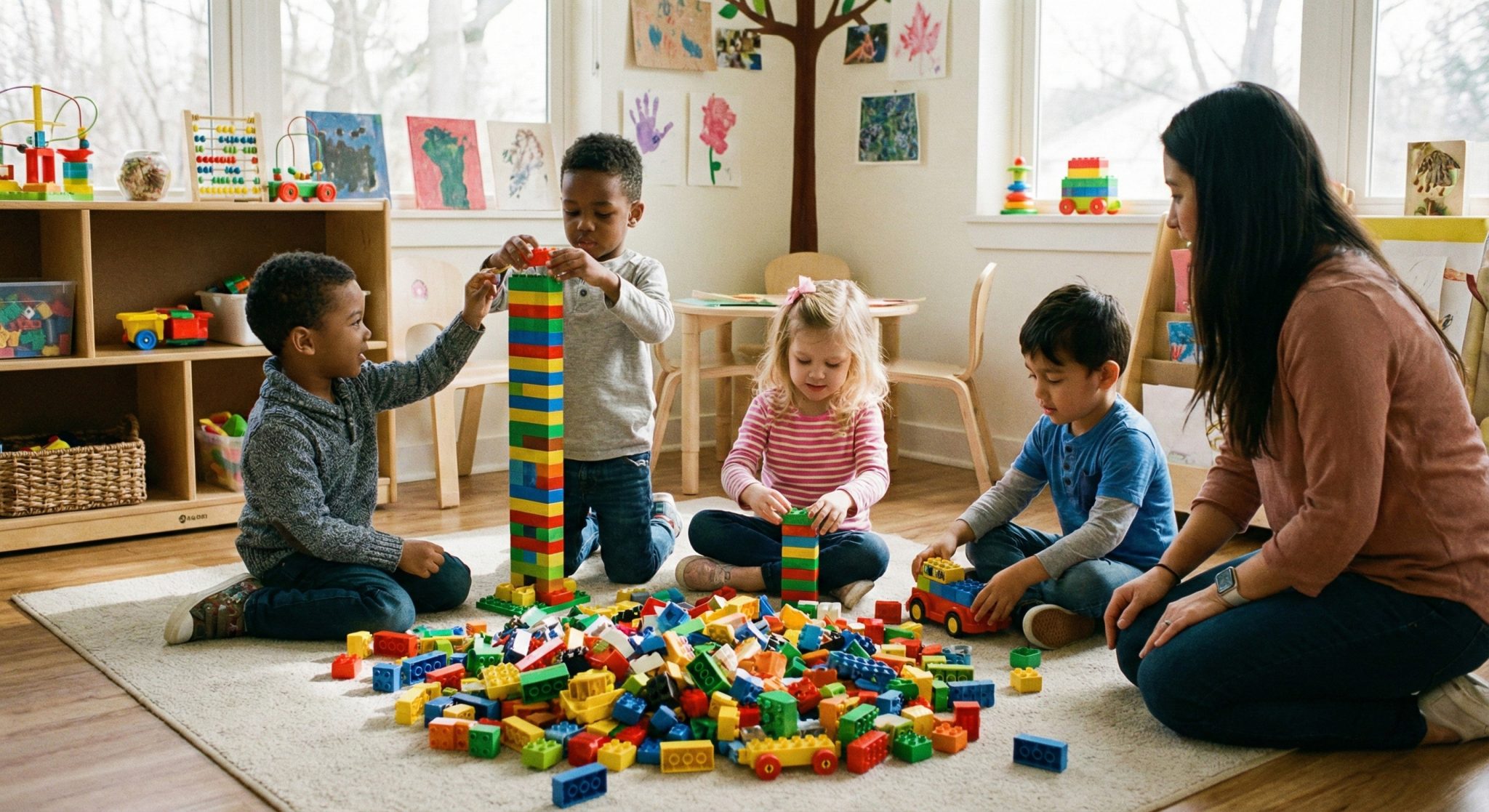
Have you ever watched a child sit in front of a pile of colorful bricks, completely absorbed in their own world? To the casual observer, it looks like simple fun. They stack, they crash, they laugh, and they start again. But if you look closer, you are witnessing something profound. You are watching a young mind grapple with the fundamental laws of physics. You are seeing a budding engineer testing hypotheses about gravity, balance, and design.
At Discovery Time Learning Center, we believe that play is the highest form of research. In our classrooms, a bin of LEGOs isn’t just a toy box—it’s a toolkit for the future. Whether it is a toddler stacking wooden blocks or a preschooler constructing an elaborate LEGO cityscape, these activities are laying the groundwork for complex cognitive skills that will serve them for a lifetime.
As parents and educators, recognizing the educational value hidden within “just playing” allows us to better support our children’s development. In this guide, we will explore exactly how block play and LEGOs translate into real-world engineering principles and why this hands-on learning is critical for your child’s growth.
Why Is Block Play More Than Just a Game?
It is easy to dismiss blocks as one of the oldest and simplest toys in the book. In an age of tablets and high-tech gadgets, why do we still prioritize wooden blocks and plastic bricks? The answer lies in their open-ended nature. Unlike a video game with defined rules and limits, a pile of blocks offers infinite possibilities.
When a child reaches for a block, they are engaging in constructive play. This type of play requires active engagement. They aren’t passively consuming entertainment; they are creating it. This shift from consumer to creator is the very essence of engineering.
Key developmental benefits include:
- Fine Motor Skills: Grasping, snapping, and aligning small pieces refines hand-eye coordination.
- Spatial Awareness: Children learn to visualize three-dimensional objects and understand how shapes fit together in space.
- Cognitive Flexibility: If a piece doesn’t fit, they must adapt their plan instantly.
By prioritizing these activities, we aren’t just keeping kids busy; we are training their brains to think structurally and methodically.
How Do Toddlers Learn About Gravity and Balance?
Have you ever noticed that a toddler’s favorite part of building a tower is knocking it down? While it might seem destructive, this is actually their first lesson in physics.
What is the lesson in the crash?
When a child stacks one block on top of another, they are experimenting with center of gravity. If they place a block too far to the left, the tower topples. Through repeated “experiments” (building and crashing), they intuitively learn that for a structure to stand tall, its weight must be evenly distributed.
How does the base affect stability?
Through trial and error, children discover that a wide base supports a taller structure. They might not know the term “foundation” yet, but they understand the concept perfectly. If they try to build an inverted pyramid—narrow at the bottom, wide at the top—it fails. If they build a pyramid with a wide bottom, it succeeds. This is the same principle civil engineers use when designing skyscrapers and monuments.
What Can LEGOs Teach Preschoolers About Structural Integrity?
As children graduate from simple wooden blocks to interlocking LEGO bricks, the engineering lessons become more sophisticated. The “snap” of a LEGO brick introduces the concept of friction and interlocking connections, allowing for structures that can defy gravity in ways loose blocks cannot.
Why is “overlapping” important?
One of the first “aha!” moments for a young builder is realizing that stacking bricks directly on top of each other (creating a vertical seam) makes a weak wall. It breaks easily. However, if they overlap the bricks—staggering the seams like a real bricklayer—the wall becomes rigid and sturdy.
This is a lesson in structural integrity. In engineering terms, this distributes the load (stress) across multiple units rather than concentrating it on a single vertical line. When your child figures this out, they are effectively using the same technique found in the masonry of your own home.
How do they learn about bracing?
Have you ever seen a child try to build a bridge between two tables? If they just lay a flat plate of LEGOs across the gap, it might sag or break in the middle. To fix it, they might add a second layer of bricks underneath. They have just invented a beam. If they add diagonal pieces to hold up a wall that keeps falling over, they are utilizing cross-bracing. These are advanced concepts derived purely from the need to solve a physical problem.
How Does Construction Play Enhance Math Skills?
Engineering and mathematics are inseparable, and block play is essentially physical math. You don’t need worksheets to teach these concepts; they are built into the bricks themselves.
- Geometry and Shape Recognition: Children constantly sort through bins looking for specific shapes—rectangles, squares, cylinders. They learn that two squares can make a rectangle, or that two triangles can form a square.
- Symmetry and Patterns: Humans are naturally drawn to symmetry. Children often build structures that are mirror images on both sides. This requires counting studs (the bumps on LEGOs) and ensuring that if they used a red 2×4 brick on the left, they need a red 2×4 brick on the right.
- Fractions and Ratios: LEGOs are a visual representation of fractions. A tiny 1×1 piece is one-fourth the size of a 1×4 piece. A standard eight-stud brick is exactly double the size of a four-stud brick. Children unconsciously perform addition, subtraction, and division as they search for the pieces that fit their mental blueprint.
What Role Does Failure Play in Engineering?
In the professional world, engineers often fail. Rockets explode, prototypes break, and code crashes. The difference between a good engineer and a bad one is resilience.
Is a collapsed tower a bad thing?
At Discovery Time Learning Center, we celebrate the “crash.” When a child’s creation collapses, it is not a mistake—it is data. It tells the child, “This design was not stable. Why?”
This process cultivates a Growth Mindset. Instead of saying, “I’m bad at building,” the child learns to ask, “How can I fix this?” This iterative process—Design, Build, Test, Fail, Redesign—is known as the Engineering Design Process. It is the standard methodology used by NASA, Tesla, and Apple. Your child is practicing it right on the classroom rug.
How Does Collaborative Play Build Teamwork?
Engineering is rarely a solo endeavor. Large projects require teams. In our classrooms, the block corner is a social hub.
How do children negotiate construction?
When two children decide to build a castle together, they must communicate.
- “I’ll build the gate, you build the tower.” (Division of labor)
- “No, the tower should be here, not there.” (Conflict resolution)
- “We need more blue bricks.” (Resource management)
These interactions teach vital soft skills. They learn to articulate their vision, listen to others’ ideas, and compromise. This social engineering is just as important as the structural engineering. It prepares them for a future where collaboration is key to success.
How Can Parents Encourage “Engineering” at Home?
You don’t need a degree in physics to support your child’s learning. You just need to be an interested observer and a supplier of materials.
- Ask Open-Ended Questions: Instead of saying “That’s a pretty house,” ask “Tell me about how you made the roof stay up?” or “What would happen if we added another block here?”
- Provide Variety: Mix it up. Use wooden blocks, magnetic tiles, LEGOs, and even recycled cardboard boxes. Different materials pose different engineering challenges.
- Don’t Fix It for Them: If they are struggling to balance a piece, resist the urge to do it for them. Let them struggle a little. The learning happens in the struggle.
- Challenge Them: Give them a “client brief.” Ask them to build a garage for a toy car, a bridge that can hold a specific book, or a tower taller than they are.
The Discovery Time Difference
At Discovery Time Learning Center, we view every child as an innovator. Our curriculum is designed to harness natural curiosity and channel it into meaningful learning experiences. We provide the resources—from diverse building materials to guidance from experienced educators—to ensure that your child isn’t just playing, but building a foundation for the future.
We understand that the skills learned in the block corner—problem-solving, resilience, math, and physics—are the same skills that will help them succeed in school and in life. Whether they grow up to be architects, software developers, or artists, the lessons learned from a simple brick will stay with them forever.
Conclusion
The next time you step on a stray LEGO brick in your living room, take a deep breath and remember: that isn’t just a piece of plastic. It is a tool of discovery. It is a lesson in geometry. It is a test of patience and a triumph of engineering.
By encouraging block play, we are giving our children the power to shape their world. We are teaching them that if they can imagine it, and if they work hard enough to understand how the pieces fit together, they can build it.
Are you ready to give your child the best start in their educational journey?
Contact Discovery Time Learning Center today to schedule a tour and see our future engineers in action. Let’s build a bright future together.
Frequently Asked Questions (FAQ)
Q: At what age should my child start playing with blocks?
A: Block play is beneficial as soon as a child can grasp objects, usually around 6 months old. Soft blocks are great for infants. Around age 1-2, they can graduate to wooden blocks and large interlocking bricks (like DUPLO). By age 4-5, most children are ready for standard LEGO bricks which require more fine motor precision.
Q: My child only wants to build from instructions. Is that okay?
A: Absolutely! Building from instructions teaches children to follow a sequence, interpret diagrams, and pay attention to detail—all critical skills. However, it is also important to encourage “free build” time where they must create their own designs, as this fosters creativity and problem-solving. A mix of both is ideal.
Q: How do blocks help with language development?
A: Block play is surprisingly verbal. Children often narrate what they are doing (“I am putting the red one on top”). When playing with others, they must use descriptive language like “over,” “under,” “next to,” “higher,” and “heavier.” This expands their vocabulary, specifically their spatial vocabulary, which is linked to later math success.
Q: What if my child gets frustrated when their creation breaks?
A: Frustration is a natural part of the learning process. Validate their feelings (“I see you are sad your tower fell”), but encourage them to try again. You can ask, “Why do you think it fell?” to turn the emotional moment into an analytical one. This helps build emotional resilience and perseverance.
Q: Do you use block play in the curriculum at Discovery Time Learning Center?
A: Yes, block play is a core component of our early childhood curriculum. We provide designated construction areas in our classrooms stocked with various building materials. Our teachers are trained to facilitate play that encourages critical thinking, collaboration, and the exploration of STEM concepts.