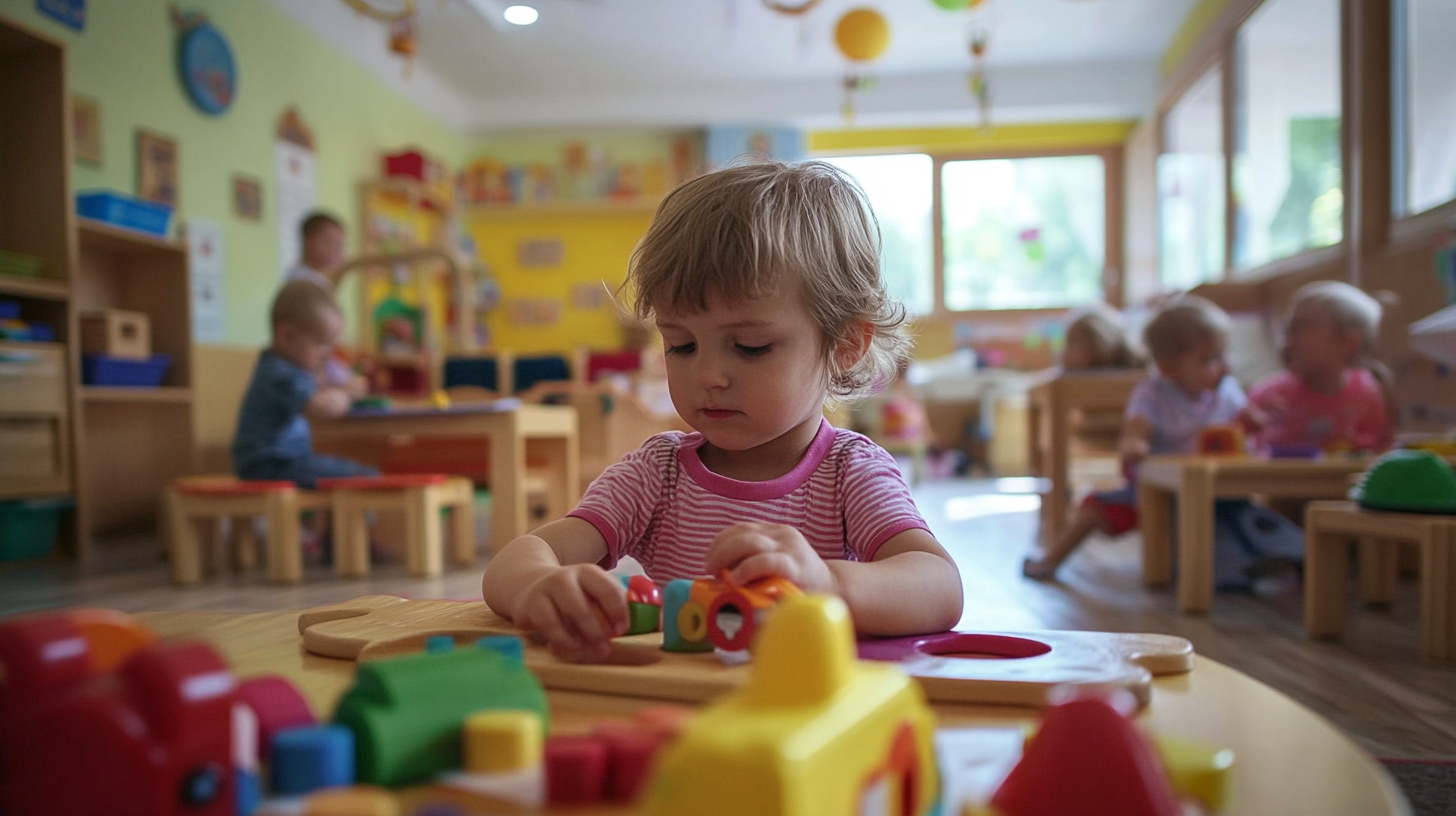
As a parent, you’ve likely watched your toddler investigate the world with boundless curiosity. They stack blocks, group their toys, and point to objects as they babble. What you might not realize is that in those simple actions, your child is already beginning their journey into the exciting world of mathematics.
Math isn’t just about numbers; it’s about patterns, logic, problem-solving, and spatial reasoning. For toddlers, the fundamentals of math are built on two concrete, hands-on skills: counting and sorting.
At Discovery Time Learning Center, we believe that early math should be fun, engaging, and integrated seamlessly into a child’s day. We recognize that laying a strong mathematical foundation during the toddler years is one of the most important steps we can take in preparing your child for lifelong success.
This guide is designed to help you understand the power of these basic skills and how expert educators and engaged parents can work together to turn playtime into powerful learning time. We’ll explore the “why” and “how” of making early math a joyful adventure for your little one.
What is the True Value of Early Math Education for Toddlers?
Many parents associate early learning with reading and letters, but a child’s capacity for understanding mathematical concepts often begins much earlier than their literacy skills fully develop. Early math education is not merely a precursor to school; it is a critical component of overall cognitive development.
When toddlers engage in foundational math activities like counting and sorting, they are actively developing several high-level cognitive abilities that are vital for success in all areas of life.
Beyond Arithmetic: Key Developmental Benefits
- Logical Reasoning and Critical Thinking: Sorting objects, for instance, requires a child to analyze and compare attributes, which is the very essence of logical thought. They must decide: Is this red? Is this a circle? This process builds the mental structures necessary for complex problem-solving later on.
- Pattern Recognition: Math is fundamentally about patterns. Whether it’s the sequence of numbers (1, 2, 3…) or the repetition of an attribute (red, blue, red, blue), recognizing and continuing patterns strengthens their predictive skills and abstract thinking.
- Spatial Awareness: Handling and manipulating objects to count or sort—stacking blocks, fitting shapes into a sorter, or lining up toys—enhances a child’s understanding of space, volume, and shape. This is crucial for geometry, navigation, and even fine motor development.
- Language Development: As children learn to associate numerical names (one, two, three) and descriptive terms (big, small, bumpy, smooth) with physical objects, their vocabulary and ability to articulate complex ideas expand significantly. Math provides a powerful context for language use.
By embracing early math, we give toddlers the tools to better understand their world, categorize information, and think critically about the environment around them. It truly is the foundation for a lifetime of confident learning.
How Do Toddlers Naturally Begin to Understand the Concept of Counting?
Toddlers are sponges, and their first encounter with counting is usually through rote memorization. Rote counting is simply reciting the number names in order (one, two, three, four…) without necessarily understanding what those numbers represent. This phase is important, but it’s just the starting line.
The Stages of Counting Development
Understanding how a toddler progresses through counting can help parents and educators provide the most appropriate support.
- Rote Counting (The Chant):
- The toddler mimics adults and recites numbers as a song or a sequence of sounds.
- They might skip numbers or start randomly, like “one, two, five, ten!”
- This shows they are aware of number words, but not number meaning.
- One-to-One Correspondence (The Touch):
- This is the critical step where a toddler learns that one number word corresponds to one object.
- They must physically touch, point to, or move an object as they say the number. This coordination is challenging and requires focus.
- An adult might model this by saying “one” while touching the first block, “two” while touching the second block, and so on.
- Cardinality (The Total):
- The breakthrough moment! Cardinality is the understanding that the last number counted in a set represents the total quantity of that set.
- If a child counts five blocks and, when asked “How many blocks are there?” they confidently say “Five,” they have grasped cardinality.
- Abstraction and Subitizing (The Leap):
- Eventually, the toddler can count objects that are not in a neat line (scattered arrays) and can even begin to subitize, which means instantly recognizing the quantity of a small group (like seeing three dots on a dice and knowing it’s three without counting).
The journey from singing a number song to truly understanding that “three” represents a group of three objects is a huge cognitive leap. Patience and repeated, playful exposure are key to mastering this progression.
What is the Key Cognitive Skill Developed Through Sorting Activities?
If counting gives a toddler a sense of quantity, then sorting gives them a sense of order and logic. The key cognitive skill developed through sorting is classification.
Classification is the ability to group items together based on a shared characteristic or attribute. It’s how our brains organize the endless stream of information we encounter every day.
The Power of Attributes
Sorting activities teach toddlers that objects have multiple, observable attributes that can be used to define them. These attributes are the foundation of logical thinking and comparative analysis.
Toddlers typically start by sorting based on the most obvious attributes:
- Color: Grouping all the red items together, all the blue ones together.
- Shape: Putting all the squares in one pile and all the circles in another.
- Size: Separating the big blocks from the small blocks.
As they grow, their sorting skills become more complex, moving to less obvious attributes:
- Function: Grouping things you eat versus things you play with.
- Texture: Separating soft items from hard items.
- Category: Grouping all the animals together, all the vehicles together.
When a toddler sorts, they are engaging in a highly focused activity that requires them to hold a rule in their mind—for example, “I am only looking for things that are yellow”—and apply that rule consistently to every item. This practice enhances executive function skills like working memory and cognitive flexibility, which are essential for academic success and problem-solving in adulthood.
Why Are Hands-On Objects and Manipulatives So Crucial for Early Math Mastery?
In the world of a toddler, the abstract concept of the number ‘3’ is meaningless. It doesn’t become real until it is attached to a concrete experience. This is why hands-on objects, or manipulatives, are non-negotiable for teaching counting and sorting.
Bridging the Gap from Abstract to Concrete
Manipulatives provide the necessary bridge between an abstract idea and a tangible experience. They allow a child to use all their senses—touch, sight, and even sound—to explore and internalize mathematical concepts.
Imagine trying to explain the concept of ‘five’ without ever showing five things. It’s impossible. But when a child can pick up, move, and hold five colorful counting bears, ‘five’ suddenly has weight, color, and a physical presence.
The Best Manipulatives for Learning:
The most effective manipulatives are often simple, familiar, and non-distracting.
- Everyday Items: Cereal pieces, blocks, socks, crayons, or even fruit. Using what’s on hand makes learning accessible and relevant.
- Nesting/Stacking Toys: Cups and rings that fit together are excellent for demonstrating concepts of size, order, and sequence.
- Sorting Trays and Bowls: Simple containers allow children to physically place items into groups, reinforcing the concept of classification.
- Counting Sticks or Pompoms: These are easily handled by little fingers and provide clear visual separation for one-to-one correspondence practice.
Through repeated interaction with these objects, the child’s brain moves the information from a temporary, sensory experience into a permanent, stored concept. When they see the abstract numeral ‘3’ later in school, their brain will instantly connect it back to the feeling of three blocks in their hand.
What Does “One-to-One Correspondence” Really Mean for My Toddler?
One-to-One Correspondence is perhaps the most critical skill a toddler must master to move from rote chanting to genuine mathematical understanding. It is the fundamental principle that establishes the link between the spoken word (the number) and the object being counted.
Simply put, it means assigning one and only one number word to one and only one item being counted.
The Common Counting Challenge
If you’ve ever watched a toddler count, you’ve likely seen them run into two common errors related to this principle:
- Skipping: Saying “one, two, three” while only pointing to two blocks, or touching a block twice while saying only one number word. They struggle to synchronize the action of pointing with the sound of the word.
- Rushing/Dragging: Pointing to the whole group of objects and saying the numbers very quickly, or saying “one, two, three…” while their hand slowly moves over the objects. Their speed is mismatched.
How to Master Correspondence
Mastering this requires deliberate, slow, and hands-on practice.
- Movement is Key: Encourage your toddler to physically move the objects as they count them. For example, have them move blocks from a “start” bin to a “finish” bin, saying the number as the block crosses the boundary.
- The Power of Slow: Model slow, deliberate counting. Exaggerate the pause between numbers and the motion of touching. Use your voice to emphasize the pairing: “One” (touch), “Two” (touch), “Three” (touch).
- Use Distinct Objects: Begin with items that are clearly separated, such as large pieces of fruit or distinct toys, before moving to objects that are close together, like items in a picture book.
This skill is the true heart of early math counting. Once a child truly understands one-to-one correspondence, they are ready to unlock the full potential of number sense.
How Can I Turn Everyday Routines into Fun Sorting and Counting Games?
The best learning environments don’t happen in a sterile classroom; they happen naturally within the rhythm of a child’s daily life. As a parent, you are your child’s first and most important teacher. You can transform mundane household tasks into powerful counting and sorting lessons with minimal effort.
Counting Opportunities Everywhere
- Stair Counting: Count the steps as you walk up or down the stairs (“One step, two steps, three steps…”).
- Snack Time: Count out servings. “Let’s count three crackers for your snack bowl. One, two, three!” This makes the abstract number relevant because it leads to a reward.
- Clean-Up Time: Count the toys going back into the bin. “We have to put five dinosaurs back to sleep. Can you find them? One, two, three, four, five.”
- Finger Plays: Use their fingers as natural manipulatives. Counting toes and fingers is a perennial toddler favorite.
Sorting Opportunities Everywhere
- Laundry: Sorting clothes is a fantastic, real-world sorting activity.
- Color Sort: “Can you put all the white socks in this pile and all the colored shirts in that pile?”
- Size Sort: Separating Daddy’s clothes from your clothes.
- Utensil Drawer: If it’s safe and you’re supervising, let them help put away clean utensils. “Let’s put the spoons here and the forks here.” They are sorting by function and shape.
- Toy Bins: Use labeled bins for different categories of toys (Blocks, Cars, Animals). When cleaning up, they must classify the toy before placing it in the correct bin.
By embedding these skills into routine, you show your toddler that math is not a subject confined to a book; it is a vital tool for organizing and understanding their entire world. Consistency is key, and a little bit of counting and sorting every day goes a long way.
What Is the Difference Between Rote Counting and Meaningful Counting?
Understanding the distinction between these two concepts is essential for assessing a child’s true mathematical progress. While both are necessary, they serve different purposes in the developmental timeline.
Rote Counting: The Vocabulary Lesson
Rote counting is simply the mechanical recitation of number names in their proper sequence. Think of it as memorizing the alphabet.
- Action: Saying “one, two, three, four, five…”
- Goal: To memorize the order of the number words.
- Cognitive Level: Basic memory recall.
- Example: A toddler says the numbers from one to ten perfectly while jumping rope, without touching or seeing any objects.
Rote counting is the necessary first step because a child needs the correct vocabulary (the number names) before they can apply it to a practical situation. It builds auditory recognition and memory.
Meaningful Counting: The Application
Meaningful counting (or rational counting) involves the actual application of number words to a group of objects, incorporating the principles of one-to-one correspondence and cardinality.
- Action: Pointing to five apples one by one, saying “one, two, three, four, five,” and then stating “There are five apples.”
- Goal: To understand that numbers represent concrete quantities.
- Cognitive Level: Logic, synchronization, and comprehension.
- Example: A toddler is asked to bring three pillows to the fort and successfully counts and delivers exactly three pillows.
A child who can rote count to twenty but cannot accurately count three crackers has a strong memory but a weak math foundation. A child who can only rote count to five but can accurately count and identify a group of five objects is mastering the more critical meaningful counting skill. The focus in the toddler years must shift quickly from rote recitation to meaningful application.
How Does Discovery Time Learning Center Integrate These Foundational Skills?
At Discovery Time Learning Center, we don’t treat counting and sorting as isolated, sit-down lessons. Instead, we integrate these foundational math skills into our entire curriculum through intentional, play-based learning that caters directly to the toddler’s developmental stage.
Our expert educators act as facilitators, creating rich, inviting environments where children are naturally driven to engage in mathematical thinking.
Our Approach to Play-Based Math:
- Intentional Design of Play Spaces: Our block areas are stocked with varying sizes and colors for natural sorting and comparing. Our sensory bins contain different shapes and textures that encourage children to count items as they scoop or sort them based on feel.
- Guided Discovery: Our teachers don’t just say, “Count these.” They guide the child with language and questions that build skills. For instance, a teacher might say, “I see you have a red block. Can you find another red block and put it next to yours? You are sorting by color!”
- Small Group and Individualized Attention: We work in small groups, allowing teachers to observe each child’s counting technique. If a child is struggling with one-to-one correspondence, the teacher can immediately step in and model the slow, deliberate action required, offering personalized correction and positive reinforcement.
- Themed Curriculum Integration: We connect math to literacy and science. If the theme is “Animals,” children might sort the animals by habitat (farm, ocean, forest) or count the legs on different creatures. This shows children that math is interconnected with everything they learn.
By providing a safe, stimulating, and expertly-guided environment, Discovery Time Learning Center ensures your toddler gains not only the skills of counting and sorting but also the confidence and enthusiasm needed to tackle increasingly complex mathematical challenges in the future. We make early math an adventure they look forward to every day.
Conclusion
The toddler years are a miraculous time of rapid cognitive growth. By focusing on the concrete, hands-on skills of counting and sorting, we provide your child with the essential building blocks for Early Math proficiency. These activities are more than just play; they are the foundation for logic, critical thinking, problem-solving, and a lifelong appreciation for learning.
From stacking blocks to sorting laundry, every interaction is an opportunity. At Discovery Time Learning Center, we are dedicated to maximizing these opportunities, ensuring your child develops a robust, joyful relationship with math right from the start. Our curriculum is designed to transform their natural curiosity into measurable, foundational skills.
Ready to see how we can give your child the best possible start?
Don’t wait to invest in your child’s future! Contact Discovery Time Learning Center today to schedule a tour and learn more about our engaging, expert-led early math programs. Give your toddler the advantage they deserve.
Frequently Asked Questions (FAQ)
What is the most important math skill a toddler should learn?
While both counting and sorting are vital, the most foundational and important skill for a toddler to truly master is One-to-One Correspondence. This is the understanding that one number word (e.g., “three”) must be paired with one and only one object in a group. Mastering this skill moves a child beyond simple rote recitation and into meaningful counting, where they actually understand the concept of quantity and number sense. This comprehension is necessary before they can move on to addition and subtraction.
At what age should my toddler be able to count to ten?
Most toddlers begin rote counting (reciting the numbers) somewhere between 2 and 3 years old. However, the exact age is less important than the type of counting they are doing. Many 3-year-olds can rote count to ten or higher. A more developmentally significant milestone is achieving meaningful counting (one-to-one correspondence) up to at least five objects, which typically occurs between the ages of 3 and 4. The focus should be on accuracy and comprehension of smaller sets, rather than on the rote memorization of large numbers.
If my toddler can sort by color, what is the next logical skill to teach them?
Once your toddler can consistently and accurately sort by a single, obvious attribute like color, the next logical step is to introduce sorting by a different single attribute, such as size (big vs. small) or shape (circle vs. square). After they have mastered two different single attributes, you can then introduce multiple attribute sorting. This involves asking them to group objects that share two characteristics, such as “Find all the big, blue blocks.” This process significantly advances their logical reasoning and classification skills.
How can I make counting more engaging than just reciting numbers?
The best way to make counting engaging is to make it relevant and hands-on. Move the focus from abstract recitation to functional application. Use tangible items that your toddler is interested in, such as their favorite toys, snacks, or nature items found outside. Instead of drilling numbers, try:
- Counting for a Purpose: “How many trains do we need to build a long line?”
- Counting Movement: Counting steps, jumps, or claps.
- Using Fingers and Toes: These are accessible, fun, and always present manipulatives.
- Modeling Slow and Deliberate Counting: Use an exciting, varied voice and physically touch each item as you count it.
How does early math foundation impact later school success?
A strong early math foundation is highly predictive of future academic success, even more so than early reading skills. Children who master counting, sorting, patterning, and spatial reasoning enter school with an enhanced capacity for logical problem-solving and critical thinking. They develop the executive functions (like memory and focus) required to tackle complex subjects. This strong foundation doesn’t just help in later math classes, but in science, engineering, and any field that requires analysis and logical sequencing.